
Tea and Sympathy │ Warner Archive Collection
Courtesy of Warner Bros. Entertainment
by CHAD KENNERK
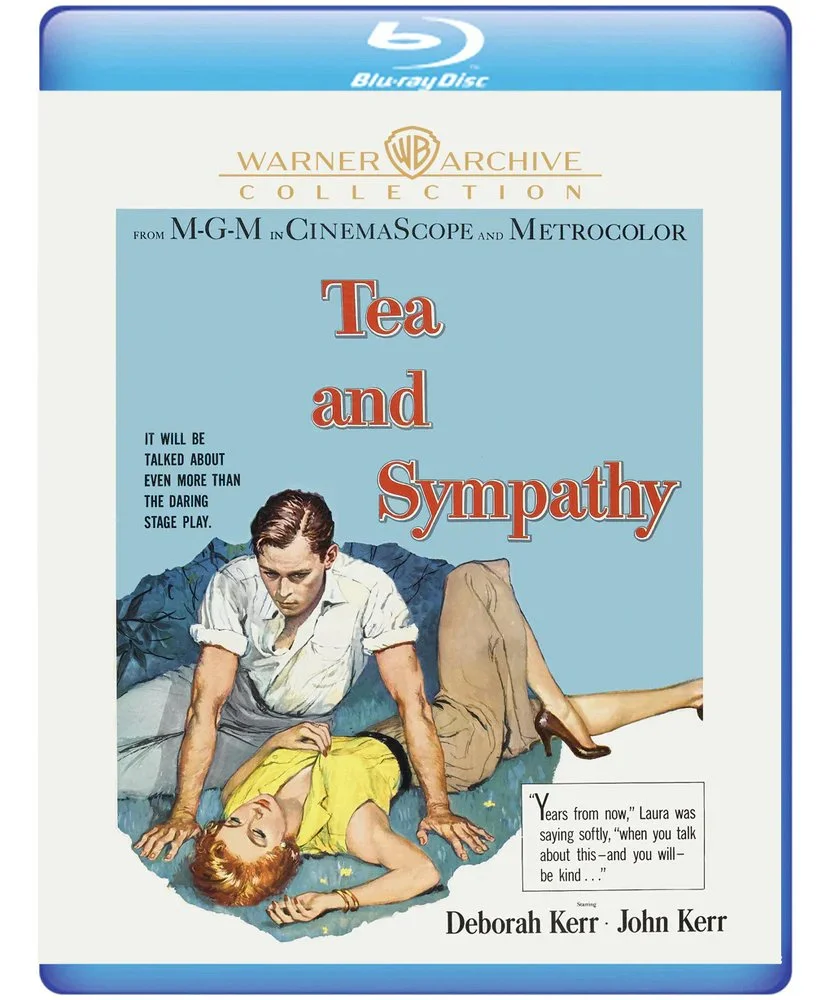
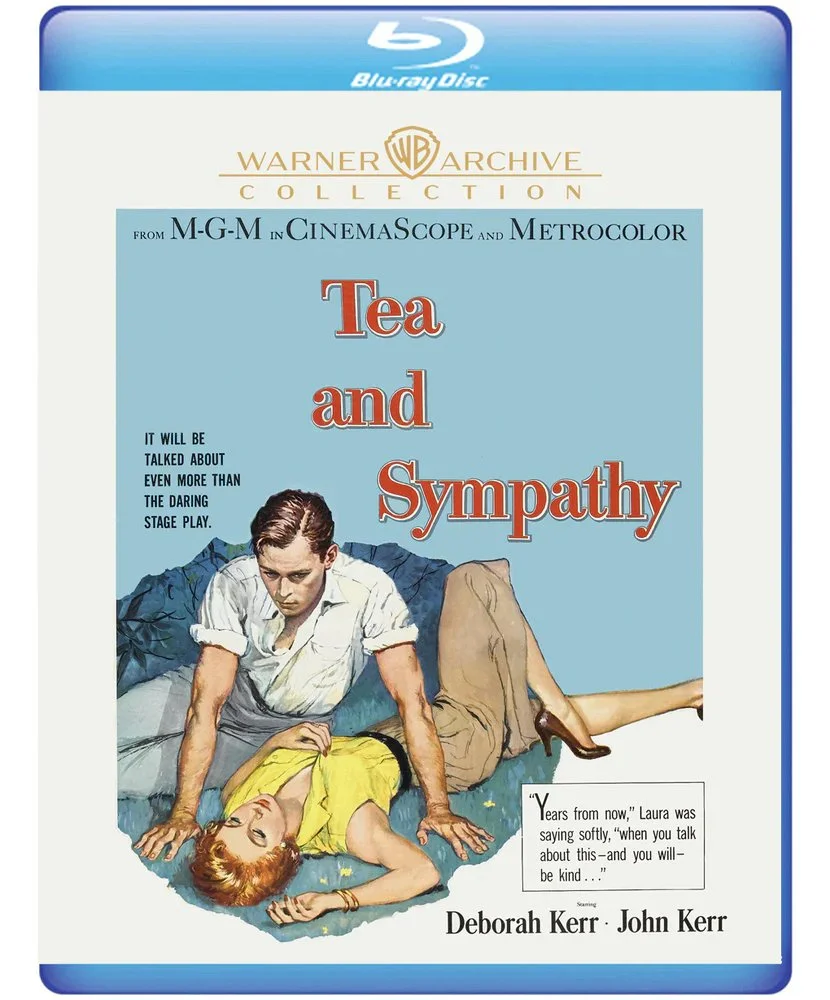
Throughout the long history of stage-to-screen adaptations, many acclaimed plays have lost something in translation – especially in the 1950s and 60s, when provocative material often faced heavy censorship. When MGM production head Dore Schary saw the 1953 Broadway production of Tea and Sympathy, starring Deborah Kerr, John Kerr and Leif Erickson (under the direction of Elia Kazan), he immediately wanted to adapt it for the screen. The story centres on Tom Lee (John Kerr), a sensitive student at an all-boys boarding school who is bullied for failing to meet traditional expectations of masculinity. Rumours about his sexuality spread among the students and faculty, while Laura Reynolds (Deborah Kerr), the compassionate wife of the athletics coach, becomes his only ally. Despite the play’s success, MGM ran into resistance from the Production Code Administration. To secure approval, Schary promised to avoid explicit references to homosexuality, instead reframing the story around nonconformity.
Director Vincente Minnelli and playwright Robert Anderson spent years negotiating censorship demands that stripped away much of the play’s original meaning. After extensive negotiations, filming finally began in 1956, mostly on the MGM lot, with the main hall of the prep school having previously housed the inmates of Minnelli’s The Cobweb. Despite fears surrounding the subject matter, preview audiences barely recognised the film as controversial. “A lot of cute boys,” and “John Kerr is very much like James Dean,” were among the initial responses. Still, the censors demanded additional cuts, while the National Legion of Decency threatened the film with a condemned rating unless the ending was softened further. Producer Pandro S. Berman cabled, “The last reel of this picture will be ridiculous and, in my opinion, should be laughed at by audiences. It is a sad state of affairs when they can not only tell us what to say but how to say it and write propaganda in their language to disseminate for them… I wish we could accept their C rating and keep our pride.” In the end, they won a B rating (‘morally objectionable for all’).
Ironically, Deborah Kerr had initially turned down the stage role, reluctant to play yet another noble, self-sacrificing woman. She eventually embraced the material and later praised Minnelli’s sensitivity, though she openly lamented the censorship compromises, saying, “I suffered with Bob Anderson, who had to make these adjustments in his play. It seems impossible that so recently one couldn’t say 'homosexual' or imply 'queer' or 'gay' even. It took something out of the movie that the boy was persecuted simply because he was not good at sports or games.” Kerr further added, “The crucial point of the play, that he had been seen swimming with a master everyone assumed to be homosexual, had to be omitted altogether; the boy was so innocent he would not even have known what that meant – he went with the man because he was nice to him – and that was all there was to it.”


Where the script could no longer speak openly, Minnelli attempted to communicate visually. His expressive use of colour – especially yellow, blue, and the green mixture of the two – subtly reinforces gender themes and sexuality. Laura is frequently associated with yellow, while the male characters are framed in varying shades of blue, tied to traditional masculinity. The film benefits from occasional expansions beyond the stage play, including Tom’s encounter at Ellie Martin’s apartment, which had only been referenced onstage.
Critical reactions were mixed. Some reviewers argued the censors had ‘used the fig leaf as an eyepatch’, while others praised Minnelli for pushing Hollywood toward greater maturity. Because the cast had lived with the material for years in the theatre, there is a kind of Sunday matinee quality to the performances. The European press, meanwhile, had a hard time understanding what all the fuss was about. Years later Minnelli saw a French production of Tea and Sympathy, starring Ingrid Bergman in the Kerr role, and, for the first time, saw the humour in it. Minnelli later remarked: “The censors refused to admit the problem of sexual identity was a common one.” He would eventually request in retrospectives and tributes of his work that Tea and Sympathy not be included.
Even with its compromises, the film remains a revealing portrait of 1950s homophobia, conformity and the policing of masculinity. Its themes also echo the paranoia of the McCarthy era, particularly in Laura’s observation, “How easy it is to smear a person.” Anderson later explained that the play was ultimately about respecting differences and rejecting shallow notions of manliness. “I attack the often movie-focused notion that a man is only a man if he can carry Vivien Leigh up a winding staircase. I stump for essential manliness, which is something internal and consists of gentleness, consideration, and other qualities of that sort, not just of brute strength.” Reflecting on the film, Anderson said, “We kept fooling ourselves that we were preserving the integrity of the theme, but we lost some of it. I feel that the stage production was indeed beautiful and brought out the harshness and whatever bite the play possessed, while the film bordered on the pretty. But it serves its purpose in preserving the performances of Deborah and Jack Kerr and Leif Erickson.”
Like many releases from the Warner Archive Collection, the Blu-ray features a strong new HD master sourced from a 4K scan of the original camera negative, resulting in another best-ever home video presentation. Extras are limited but include the Tom & Jerry cartoon Down Beat Bear and the original theatrical trailer.
Tea and Sympathy is available on Blu-ray 31 March from Warner Archive Collection.
Order your copy from Movie Zyng
WARNER ARCHIVE COLLECTION offers thousands of film and TV series direct from Warner’s studio vault. With a particular emphasis on high-quality restorations and remasters on Blu-ray disc, Warner Archive Collection brings rare and hard-to-find classic motion pictures and television series to home video. Often appearing for the first time on Blu-ray, titles are chosen each month from the unparalleled library of Warner Bros. Entertainment, which spans more than 100 years of cinema history.
MOVIE ZYNG offers more than 37,000 in‑stock titles, carefully curated to make discovery easy, intuitive, and genuinely enjoyable. Instead of endless search results, Movie Zyng has organised their catalogue into thoughtful collections by genre, era, studio, filmmaker, format, and fan interest. Movie Zyng is designed to help you discover films you’ve never seen, rediscover favourites and build a collection. Remember the video store? That sense of discovery, excitement, and connection has largely disappeared from modern online shopping — and that’s exactly what Movie Zyng aims to bring back. Start your collection today!